
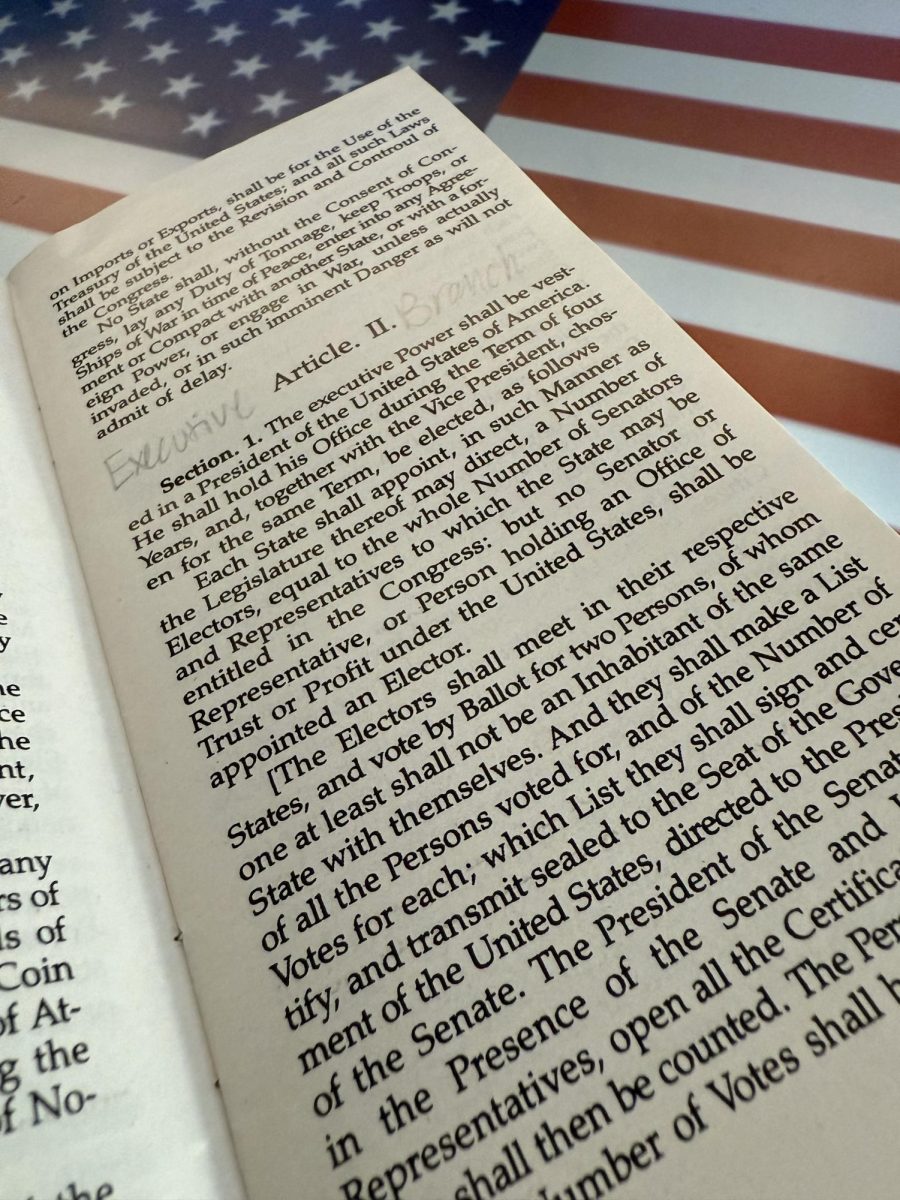
Article II of the Constitution establishes and outlines the Executive Branch, headed by one person: The President of the United States (POTUS). Every four years, a new POTUS is elected, but how exactly does this happen, and what can the POTUS do once elected into office?
The official requirements to become president begin with age. A person can only be in office if they are at least 35 years old, though the youngest president ever elected was John F. Kennedy, elected at the age of 43. Interestingly, Kennedy is not the youngest person to hold office; Theodore Roosevelt took office at 42 after the death of President McKinley.
The next requirement has to do with a person’s citizenship and residency. Unlike Congresspeople, a president has to have been born a citizen of the United States, and they are required to have lived in the US for at least 14 years. Age, citizenship, and residency requirements can be found in Article II, Section 1, Clause 5 of the Constitution.
If these standards are met, a person can officially run for office. Since 1790, when the Federalists and the Democratic Republicans were facing off, US politics have operated on a two-party system. Today, the two major parties in the US are the Democrats and the Republicans (sometimes called the Grand Ole Party, or GOP). For a person to be elected as president, an unofficial requirement is to be supported by one of the two major parties. It is technically possible to skip this step and still become president, but because of the national network of the two parties, it’s unlikely. The only unendorsed candidate to win office was George Washington, who won office prior to the formation of political parties in the US.
Another unofficial requirement to obtain the presidency is to have been born a man. Of all 45 POTUSes, zero have been women. In 2016, Hillary Clinton was the closest a woman has been to winning office, and in 2020, Kamala Harris made history by becoming the first female Vice President (VPOTUS). Though aside from being the tiebreaker and leader of the Senate, the VPOTUS does not have much significant formal power. Harris and Clinton, however, are not the closest a woman has gotten to the presidency. In October of 1919, Former President Woodrow Wilson suffered a stroke, becoming partially paralyzed and bedridden. His wife, Edith Wilson, secretly took over her husband’s role while keeping the extent of his condition hidden from the general public.
After being born a man and a citizen of the US, living in the US for 14 or more years, turning 35, and being supported by one of the two major parties, the next step is winning the election. One of the most important aspects of becoming president, and also something often confused, is the Electoral College. It is a common misconception that whichever candidate receives the most votes becomes the president. In reality, five US presidents who lost the popular vote were elected to office. This is because of something called the Electoral College. Each state has the same number of Electors as they do Congresspeople and the District of Columbia (DC) has three Electors. Each Elector is appointed by their respective state or district. States with high populations, such as California, have more Electors than states with low populations, like Wyoming.
The popular vote of each state and DC determines to which candidate all the Electoral votes of that state go. This gives candidates an incentive to do lots of campaigning in swing states, states that have lots of Electors and could vote for either candidate, such as Pennsylvania. Conversely, candidates do less campaigning in states with few Electors or states that are already likely to vote a certain way. In total, there are 538 Electoral votes to be won in a presidential election, and whichever candidate receives the most wins office.
The Electoral College is a highly debated topic whenever it comes time to elect a president. It was originally proposed at the Constitutional Convention as a compromise between big states and small states. Small states wanted Congress to choose the president, whereas big states wanted the POTUS to be elected entirely democratically. Proponents of the Electoral College claim that it appropriately represents both states and the people, provides a check on the will of the people, and ensures cohesiveness of the nation by requiring a distribution of support. Opponents of the College argue that the College gives too much power to too few states, lowers voter turnout, and does not always reflect the will of the majority.
Every four years on the first Tuesday after the first Monday of November, presidential elections are held and every eligible person is encouraged to vote. Once a candidate is declared the winner, that person becomes the president-elect until January 20 when they are inaugurated and become president.
Once inaugurated, the POTUS will nominate people to become members of the Cabinet which will be either confirmed or rejected by the Senate. Currently, President Donald Trump has 15 cabinet members, including notable names such as Attorney General Pam Bondi and Secretary of Defense Pete Hegseth, plus his Vice President JD Vance. The Cabinet executes the duties given to them by the sitting president and can be called to testify at any time by both chambers of Congress.
The POTUS is also often referred to as Commander-in-Chief of the military, but this does not mean that the POTUS can do whatever they want with the military. For example, the POTUS does not have the ability to declare war. The War Powers Resolution (WPR) was passed in 1973 after Congress overruled the veto of Former President Richard Nixon. The WPR requires the POTUS to, if possible, obtain Congressional approval prior to sending troops into foreign countries. If Congress is out of session and it is not possible for the POTUS to get approval, the POTUS has 48 hours to report to Congress on why the action is required. If Congress does not declare war or authorize the action within 60 days, the use of Armed Forces must be terminated.
The POTUS is also Constitutionally required to give a State of the Union (SOTU) address, and typically occurs at the beginning of each year. He gives the speech to both chambers of Congress, and in this speech, the POTUS will bring attention to matters he deems necessary. Recently, President Trump gave the longest SOTU address, lasting for one hour and 48 minutes. Topics that President Trump talked about in his 2026 SOTU address include the state of Iran, his struck-down tariffs, immigration, and the situation in Venezuela.
To say the least, being elected president is a difficult task, and being the chief executive of the biggest military and economic power in the world is even harder. Because of the complexity of the job, it is important that the US picks a qualified president and that voters educate themselves on candidates to use their vote wisely.