

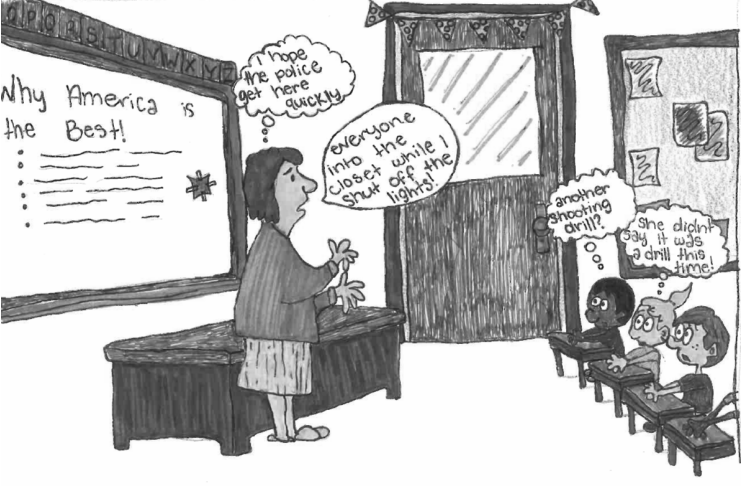
How far would you go to protect gun rights? How many “incidents” would you turn a blind eye to, in order to defend the right to own a gun? How many horrors would you excuse to uphold the Second Amendment? How many people have to die? How many kids?
How many bulletproof backpacks have to be made? How many memorials?
At what point do we reach extremes? If children being locked inside a church and shot at through the skylight isn’t enough, what is? Some things aren’t fixable through “thoughts and prayers.” Some things are real issues that need real solutions.
In 2025 alone, there have been 146 incidents in K-12 school buildings. This count consists of every time a gun was fired, brandished, or when a bullet hits the school property. There have been 91 incidents where a gun has been fired on school grounds, leaving 86 injured and 31 murdered.
The number of students exposed to school shootings has tripled since 1999.
Every day in America, an average of 327 people are shot. 117 of those people die. Approximately 47 of those deaths are murders, and 66 are suicides. The rest of those 117 are a mix of unintentional shootings, legal situations, and unknown intent. Approximately 210 of the 327 people survive but end up injured.
23 children between the ages of one and seventeen are shot every day. Six of them die from gun violence.
Waterford High School has a four-period class schedule, each around 85 minutes. For every 85-minute block a Waterford High student sits through, there are 10 people shot in the United States.
Sitting through class doesn’t seem so bad anymore when you really think about it, right? Surely students should be grateful to sit, trapped in a school all day, tucked away safe and sound from the risk of gun violence. Shielded from the dangers of guns and protected by their school.
Except we aren’t. No one is.
Gun violence is far more common than it should be, especially in schools. In a place where kids are supposed to feel safe, there are millions of kids in America walking into school every single day, fearing for their lives.
The Pew Research Center held a survey in April of 2024 and found that seven out of ten American teachers reported being extremely afraid to go into work due to the risk of a school shooting happening at their school.
Pew Research also released a 2025 analysis that discovered the most common reason for homeschooling was because both parents and students fear school shootings.
This isn’t a global issue; it’s an America issue. Canada has had a total of 19 school shootings since 1884. In the United States, there have been 1,375 school shootings between 2000 and 2022 alone.
After asking several people how often they hear about school shootings, the majority of the group claimed they hear about them around once a month. A notable point comes from senior Lucy Walker, who mentions: “They definitely happen more often than that, but I feel like I don’t hear about them that much.”
There are far more school shootings than those that reach the news. The national news only broadcasts mass casualty events, such as Sandy Hook. The chance of being on the news depends on how many people die. The problem of gun violence in schools is so bad that now the news channels are picking which school shooting is significant enough to broadcast.
The United Kingdom has an average of 0.05 gun-related deaths per 100,000 people. The United States has an average of 13.7 gun-related deaths per 100,000 people.
What difference would have to be made in order to bring down that number?
In the UK, gun ownership is a privilege, not a right. To own a gun, citizens need to obtain a Firearm Certificate and/or a Shotgun Certificate from the police, which proves they have a good reason to own a gun, such as hunting or for sport. Self-defence is not considered a good reason in the UK to own a gun.
The process to purchase a gun is a long and rigorous process. Consisting of police interviews, reference checks, and home inspections to ensure safe and secure storage of said gun. The UK has banned private ownership of most handguns, automatic weapons, and most semi-automatic rifles. Carrying a firearm in public is extremely restricted in the UK; there are few exceptions, all of which where a permit is required and the gun is only being transported for an accepted reason.
Quite a stark difference from the US.
In the US, gun ownership is protected by the Second Amendment right to bear arms. Each citizen can own a gun in the name of self-defense. Background checks are done by licensed dealers on buyers through the National Instant Criminal Background Check System (NICS), which is essentially the FBI checking if the buyer has any sort of criminal record. If so, they are denied the right to purchase a gun. However, private sales between individuals are not subject to federal background check requirements.
The US has a wide range of guns available for ownership, and certain firearms are heavily regulated, but none are federally outright banned. Limitations on what guns citizens can own vary depending on the state. In the US, the ability to carry a firearm in public varies by state as well. Some states even have “permitless carry,” where no permit is required to carry a concealed or out in the open firearm.
When asked, “What do you believe needs to happen for less school shootings to occur?”
Junior Davidson Sheppo replies with: “Add more restrictions to gun laws, like more restrictions on owning guns specifically. If you own a gun, I think you should have to do some sort of mental health evaluations every once in a while.”
Officer Norm brings up how mental health is an important aspect when answering this question, saying, “Screenings for mental health would help a lot with who should or shouldn’t have access to a gun. Statistics show for the most part that these shootings are individuals that have back stories of mental health or emotionally unstable personality disorder (EUPD).”
If the United States were to adopt the same gun regulations as the UK, the number of school shootings would decrease tremendously, along with gun violence as a whole. While gun violence is inevitable, the amount of gun violence around the country isn’t. To stop gun violence is to protect millions of kids, save countless lives, and make a safer environment for every single individual attending school. To stop gun violence is to regulate guns.
