

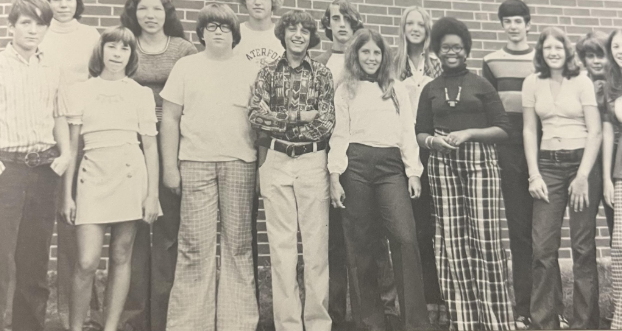
Fifty years ago, students at Waterford High School were living in another world: the fashion, education, technology, and culture were vastly different. Bell bottoms have been traded out for leggings and baggy jeans, and big hair is no longer the social norm. Back then there were no cell phones – only a five cent payphone in the building.
Here is a brief look at what has changed from then and now.
Fashion
The ‘70s were full of disco and iconic vintage styles. Bell bottoms were a popular pants style for the decade, and the trend grew in popularity from The Sonny & Cher Comedy Hour, where they were worn by couple singing duo Cher and Sonny. The Zeitgetist fashion website notes, “their flowy silhouette and high-rise were ideal for dancing the night away.” Tie-dyes gained popularity during the Hippie movement of the late ‘60s and went mainstream in the ‘70s. Many tie-dyes were made at home, showing creativity and expression in fashion trends.
Stevie Nicks, singer from band Fleetwood Mac, was a ‘70s style icon known for her bohemian style. She was often seen in a pair of chunky clogs, shoes that existed in Asia and Europe for centuries before they grew to be a trend in America. Halter tops and tube tops were one of the most popular tops in the decade, seen in shows like The Love Boat, and other popular shows of the decade.
Oversized collars were a key part of fashion, with men’s and women’s jackets and button ups featuring pointy oversized collars. Kaftan dresses were a classic that entailed a bit of cultural appropriation. Women in the Middle East and Africa have worn the style for centuries as a traditional dress, however, in the 60s and the 70s they grew to be fashionable worldwide. 1975 had numerous different and creative styles that marked the essence of the 70s.
Sports
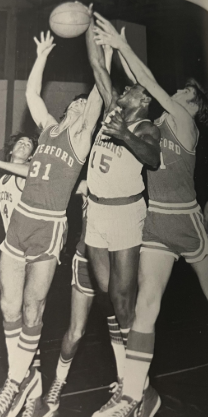
Waterford High School was in the midst of a golden age of Lancer sports. The football team posted records of 8-1, 9-0, and 8-1 from 1973 to 1975 under the guidance of legendary coach Dick Cipriani. The Lancers were ranked 6th and 5th in the state poll those years – a feat that has never been duplicated since then.
Francis X. Sweeney was the boys’ basketball coach in that era. Today, Waterford’s field house is named in his honor.
Joe Pinkham, a senior linebacker on the ‘75 football team and a baseball player, stated “Sweeney was the greatest guy ever. He would never forget your name even years after you were in high school.
One Major difference in Waterford sports 50 years ago, though, was the fact that girls sports teams were just developing after Title IX legislation in 1972 (federal civil rights law that prohibits sex-based discrimination in any school or education program funded by the federal government).
Technology
One of the biggest differences between then and now is how much technology has evolved. Currently, students come to school with a phone in hand and most are active on social media. In 1975, technology was just beginning. The ‘70s saw the launch of the first personal computers, like the Altair 8800 and IBM 5100, the founding of Microsoft where Bill Gates and Paul Allen created Altair BASIC (the first software for personal computers), the introduction of the video cassette recorder, the first self-contained digital camera, and the first interactive fiction text game (Colossal Cave Adventure), only some of the many digital advancements during the year of 1975.
These are, however, very different from the technology we have today. The massive worldwide spread of Artificial Intelligence demonstrates how much technology has evolved from 50 years ago. People can now connect from across the globe, compared to when communication was only in person. Students now have lots of access to various websites and information. In 1975, people couldn’t just simply google any question they had, if they wanted to find an answer they had to visit a library and obtain a book, read the newspaper, or ask someone. This contrast demonstrates how many resources students now have with the development of technology.
Education 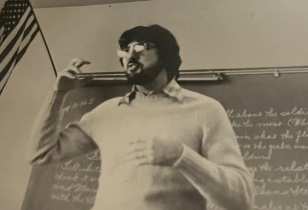
In 1975, the educational landscape was a mix of tradition and change. The landmark Education for All Handicapped Children Act (EHA) was on the horizon, assured to revolutionize equity in schools by mandating access for students with disabilities.
Teaching styles still leaned heavily on lecture-based instruction and memorization, though whispers of progressive methods were growing louder.
The curriculum, while comprehensive, often felt disconnected from the real-world experiences of students, empathizing theoretical knowledge over practical application.
Enrollment trends saw a steady rise in secondary education, but the gap in resources and opportunities persisted along racial and socioeconomic lines, making equity an ongoing challenge. For students at Waterford High School 50 years ago, these educational shifts were laying the foundation for the opportunities and challenges they would face in a rapidly changing world.
