
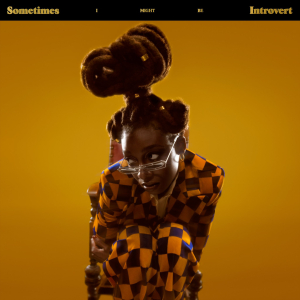
Sometimes I Might Be Introvert is Little Simz’s fourth studio album, releasing September 2021 after her critically acclaimed album Grey Area. In the album, Simz explores her roots, including her poor British upbringing, Nigerian heritage, and classic hip-hop influences. Above all, Simz explores what it means to be a woman, and the effect that being a woman has had on her life.
Throughout the album, Simz explores themes of contradiction, feeling inadequate, and femininity. She also raps about her relationship with her father and how it’s influenced her life, as he wasn’t present for a large portion of her childhood. Simz also makes many allusions, direct and indirect, to other rappers who have influenced her. Ultimately, this album is a celebration of Simz’s journey to where she is in life, and how she got here.
Upon its release, Sometimes I Might Be Introvert was lauded by critics, who praised its scope, depth, and execution. On Metacritic, a review aggregator which assigns rankings on a normalized scale, the album received an 88 out of 100. Several publications, such as BBC Radio 6 Music, Hip Hop Golden Age, and Exclaim! ranked it as the best album of 2021 in their end of year ranking list. The album won the Mercury Prize for Album of the Year, the MOBO Award for Album of the Year, and the Libera Award for Best Hip-Hop/Rap Record, in addition to being nominated for several other awards.
The album opens with “Introvert”, a proud battle cry that immediately sets up contradictions within the album. The title implies a quiet, timid song, yet the song contains a powerful fanfare that drives the song. Simz raps about the corruption present within the government and her activism, while Cleo Sol, featured on the track, provides contrasting notes of happiness and hope. At the end of the track Emma Corrin, most famous for playing Princess Diana in Netflix’s The Crown, sets up the next track.
In “Woman,” Simz opens with a series of double entendres that demonstrates her mastery of wordplay while simultaneously complimenting African women. This song is Simz’s tribute to the women in her life, around her, and throughout the world.
After these opening two tracks, Simz moves into a stronger hip-hop vibe; talking about “Tow Worlds Apart” Simz says, “You had the opener, followed by a nice, smoother vibe, but this is like, ‘Hey, you’re listening to a rap album.’” Simz flows through “Two Worlds Apart” and “I Love You, I Hate You,” exploring various contradictions within her life and her relationship with her father, a recurring theme throughout the album.
In “Little Q,” Simz introduces a new character to the album: the eponymous Little Q, who is Simz’s cousin. These two songs are from the perspective of Q,
After the brief arc of Little Q and the interlude “Gems,” Simz moves to a pair of songs that work together to set up the theme of prowess throughout the album. “Speed” is Simz’s take on a braggadocious track that sets herself up as one of the greatest rappers of all time. Within this track, Simz references Nas’s classic diss track “Ether,” where he claims the title as King of New York over Jay-Z, similarly, Simz claims the title as greatest of all time. After this track, Simz awards herself with “Standing Ovation,” celebrating herself and the power she wields.
Yet, right after claiming to be the best, Simz follows the theme of contradiction and questions herself on “I See You.” Simz returns to her insecurities, but talks about the love she’s felt and how that has helped her. After “The Rapper Who Came To Tea,” an interlude based on a children’s book, Simz moves to “Rolling Stone.”
On “Rollin Stone,” Simz further explores her relationship with her father and the effect he’s had on her life, while also introducing another dynamic: that of alternate personalities. This is not a new idea to any hip-hop fan; from Eminem’s Slim Shady to MF DOOM’s entire career to Tyler, The Creator’s host of characters (including Wolf Haley, Igor, Tyler Baudelaire, and Big Poe), hip-hop artists have experimented with alter egos. Little Simz pictures herself as Simbi, while creating an alter ego, Simz, that represents the dark side of her thoughts and actions. After “Rolling Stone,” Simz moves into “Protect My Energy,” where introversion rears its head again. She talks about her desire for isolation and her defensiveness, and connects it to her father.
After being introverted (and another interlude), Simz returns with Point and Kill. This song features Obongjayar, another Nigerian-British music artist, and was recorded in Simz’s living room on a whim. The song returns to themes of power and strength, which are furthered in “Fear No Man.”
After one final interlude, Simz moves to her pair of closing tracks, “How Did You Get Here” and “Miss Understood.” In “How Did You Get Here” Simz reflects on her journey to where she is now, reminiscent of songs like “2009” by Mac Miller and “2007” by JID. She talks about how her darker side, Simz, is part of the reason she made it this far. Talking about “Miss Understood,” Simz says “This is the perfect closer. I could have ended on the last track, easily, but, I don’t know, it’s kind of like doing 99 reps. You’ve done 99, that’s amazing, but you can do one more to just make it 100, you can.” Simz also uses this track to emphasize her femininity: either you acknowledge it and she’s Miss Understood, or you don’t and she’s misunderstood.