


A 20-year tradition, the Encountering Survivors program has come to Waterford High School this year with Romana Primus, the daughter of famous Auschwitz survivor, Sigmund Strochitz.
In his early life, Strochitz was raised in a politically educated family that paid attention to the radio. Strochitz’s father, a well-off businessman in their hometown of Będzin, Poland, used to pay attention to the events occurring around the world. He saw what Hitler was doing to the German Jews and, after many failed attempts to get visas in order to leave Europe, he built his family a shelter to hide in just in case the Nazis decided to invade Poland and conduct the same discriminatory practices on the Jews in Poland as they had in Germany. This shelter would be a saving grace, considering the Nazis invaded Poland in 1939, leading to the beginning of World War II.
Będzin is a small town about the same size as Waterford was close to the border of Germany and Poland, leading to its invasion. When the Nazis began to invade, the Strochitz family hid in their bunker. To get food and supplies for their family, they would alternate people leaving to find and buy food with cash that they had saved in preparation. Once, on his own accord, Strochitz made a long journey to the Soviet Union to ask his cousin in the government for help with asylum, but she denied him. He returned to the bunker unsuccessful and was able to survive in the bunker with his family up until they were found in 1943 and sent to the Auschwitz concentration camps, specifically Birkenau.
Strochitz was not in the bunker that day, however, so he was not caught with the rest of his family, and that was a stroke of luck.
On his family’s way to the Auschwitz camps, a Jewish man also on the transportation train with the rest of Strochitz’s family pulled a gun on the resident Nazi guard and shot at him but ultimately missed. Because of this act of rebellion, the Nazis killed everyone on the train, murdering Strochitz’s whole family while he was hiding for his life. He would ultimately be caught by Nazi soldiers a couple of weeks after the raid of their bunker.
Birkenau was a death camp, so guards did not care much for the lives of the Jewish slaves they had kidnapped. In this camp, they were given little food and water and were given extremely thin clothes and no shoes, even though the temperatures were harsh, and scrapes on feet could mean death.
At Birkenau, Strochitz worked in a factory that they called Canada, a semblance to that Canada was known to be a haven at the time. There, he sorted through the shoes that had been taken from the people who had been killed in the gas chambers when they had first arrived.
Strochitz experienced many strokes of luck in his two years as a prisoner of the Nazis.
Once, the Nazis had the prisoners marching in rows, and in Strochitz’s row, the man in the row in front of him had stumbled due to his malnourishment and the heaviness of the axes that they were carrying, which resulted in the guard shooting the fallen man and asking Strochitz to pick up the dead man’s axe in addition to his own. It took Strochitz some time to pick up both axes, so he was left to walk to the back of the rows. This played in Strochitz’s favor because the guard then shot everyone in the rows in front of him, so if he had not been told to pick up the other axe, he would have been shot.
Another time, a fellow prisoner at Birkenau had snuck off to the front entrance of the factory where Strochitz worked and asked him for shoes. A guard had seen him but told him to go away immediately or he would shoot him, however, the guard had gotten distracted with something else and had left Strochitz and the man alone. When the guard left, Strochitz threw the man a pair of shoes, an act of kindness that he would forever be grateful for because when he was sent to another camp, the man was the “camp doctor” and was able to get Strochitz and his friend Romek out of the camp and on a transport to a camp with better conditions.
Most of the Jewish people in the camps died, but some survived long enough to be liberated by the British in April 1945. The British moved the survivors to a nearby German army camp, which they converted to a Displaced Persons (DP) camp. Strochitz fell in love with Rose, a fellow Polish survivor he had met at Birkenau, and they married in the DP camp.
In 1951, the Strochitz family moved to America and, having gone to college for business (although he was expelled for being a Jew before the invasion), Strochitz would use his extensive knowledge of how a business should be run to eventually own Whaling City Ford in New London. Strochitz would also help establish the United States Holocaust Memorial Museum in 1993. He would also become best friends with the famous Holocaust survivor and author of Night, Elie Wiesel.
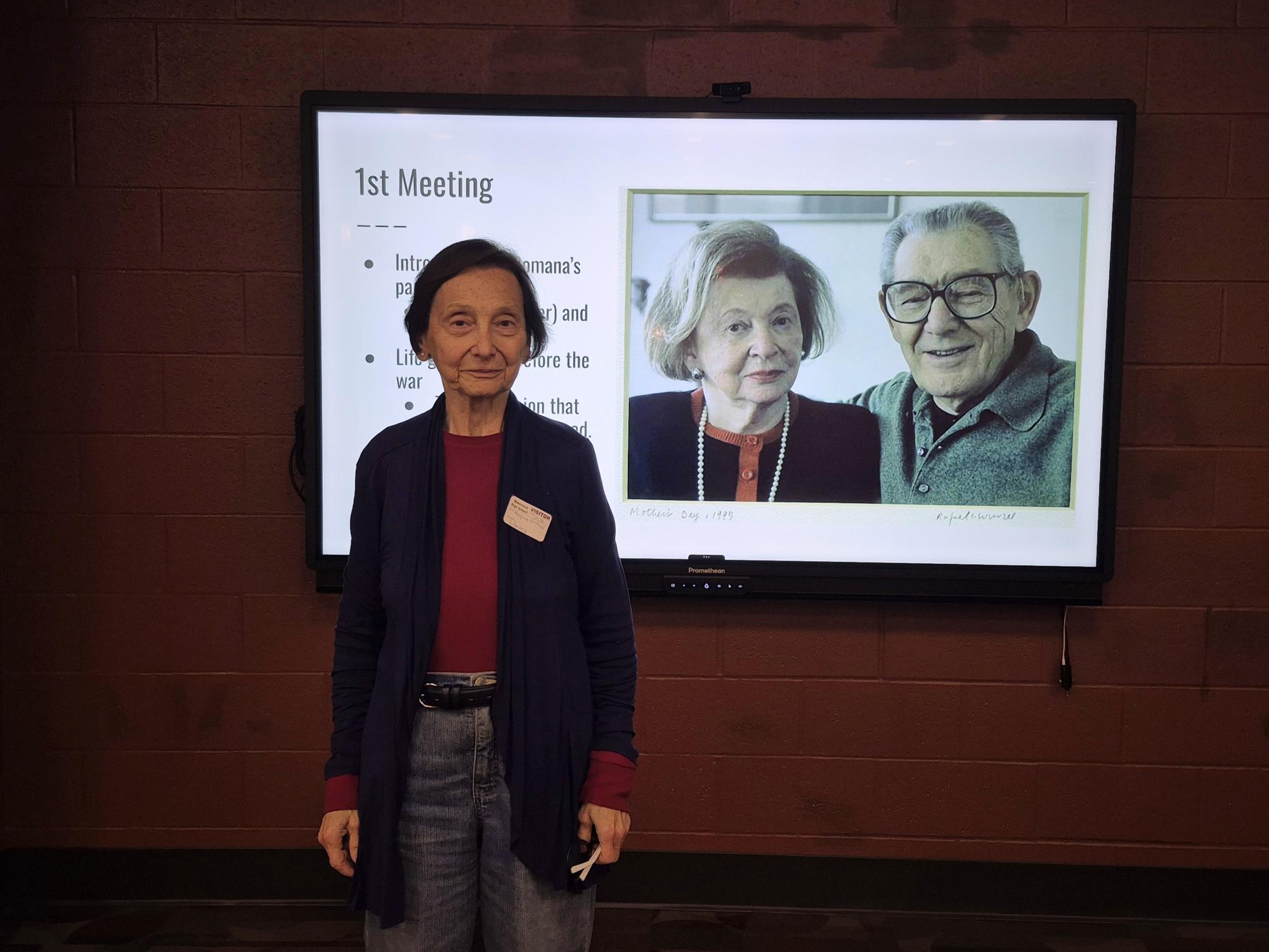
When asked if her father would have anything that he would want to say if he was here today, Dr. Primus suggested that Strochitz would have said, “You never know whether something that happens to you is good luck or bad until you can look back at it.” She also reminded students that “it is really important for you to speak out against hate speech and discrimination. Don’t be a bystander.”
If you would like to learn more in detail about Sigmund Storchitz, you can watch this video of his interview conducted by the United States Holocaust Memorial Museum.
