

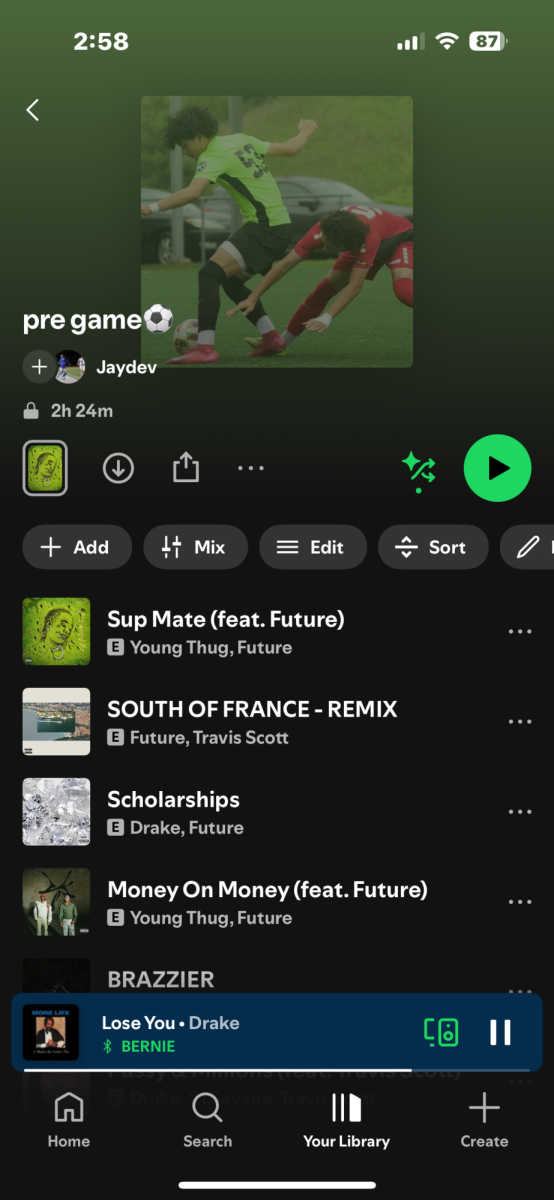
It’s an hour before the game, headphones on, you’re thinking about the game, you’re getting into the zone. You visualize success during the game as the music in your headphones plays loudly enough to block out all external noise. You’re tapped on the shoulder, time to go warm up, you’re ready to play.
Music doesn’t just sound good, it actually affects how the brain works. It’s commonly known that listening to music before an athletic event can improve motivation, endurance, strength, and more, but what actually causes this to happen?
Dissociation is a feeling of being disconnected from your body, thoughts, and surroundings. Dissociation allows for someone to be able to look past feelings of fatigue during a performance. A study conducted at Brunel University in the UK discovered that music could reduce a person’s rate of perceived effort by 12% and can improve endurance by 15% (The Health Sciences Academy).
In addition to dissociation, music triggers the release of dopamine, a natural chemical in the brain that is associated with motivation and reward (PBS Newshour). As dopamine levels rise, athletes feel more confident, energized, and mentally prepared to compete. As cortisol levels decrease, coordination and motor control improves, due to the brain’s motor cortex’s reaction, allowing athletes to get into a flow state and proper rhythm.
Research suggests that there’s no specific type of music that gets athletes ready for a game, it is a personal decision that athletes can make based on their own liking. Some athletes feel they benefit more from listening to slower, more chill, and calmer RnB and rap, because it makes them feel more laid back and confident for the game. Athletes that enjoy rap before games, can argue that their loud and aggressive music makes them feel pumped and energized for the game. It all depends on that specific person’s liking, that releases the most amount of dopamine.
Mateus mentioned listening to artists such as Drake, Kendrick Lamar, and Playboi Carti, as his go-to artists before stepping onto the field.
Junior Brayden Michonski explains that music before a game “puts me in a certain mood…like a killer mindset,” helping him to flip a switch and lock in mentally.
What both students described points to a shared experience among athletes: music allows them to feel more prepared and mentally locked in before performing.
By the time it’s time to compete, the headphones come off and the music stops. The mindset stays. The confidence and focus built before the game carry into the performance. What seems like a simple habit or just any superstition, can have a powerful impact.
