
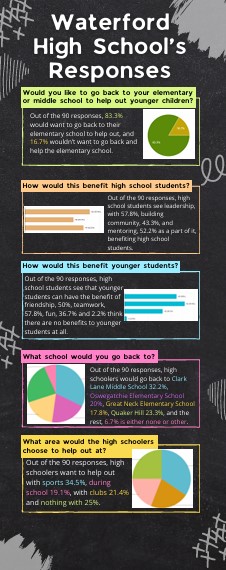
Most high school students never return to their former middle school or elementary school. Waterford High School classes are trying to bridge the gap by working with younger students across the district.
Courtney Hesch, teacher of the ECE: Love It, Teach It class, has used her class to help her students connect with the younger schools in our district. This class has visited several grade levels, including a four-hour visit to Oswegatchie Elementary School (OSW).
Hesch stated that the students “also visited Clark Lane Middle School and toured several of its classes for three hours.”
Hesch says, “[I] absolutely [think the younger kids look up to the high school students]. It was hysterical at the elementary school when the little kids were enthralled with our seniors’ backpacks. It definitely made some of them more approachable to the small kindergarteners, and it was hard to pull my students away from recess with the elementary kids when our bus showed up. The younger students were thrilled to have them, so I might have to spread the wealth next year, so we can see more elementary schools.”
Mrs. Hesch thinks connecting the schools, if structured, “is beneficial to [do] more often” throughout Waterford Public Schools. Before the COVID-19 pandemic, OSW had high school helpers, but that has since stopped.
Mrs. Balisciano, our Early Childhood Education Internship teacher, visits the elementary schools 25 times during one semester and works with students from Pre-K through second grade. When the student interns go to the schools, they help students one-on-one, as well as lead their own whole-class lessons. Little kids look up to the older kids and are more interested in their lessons, wanting to learn new things.
Balisciano says, “Students like to be in leadership roles; they think it is refreshing to be out of the building and with new people. They love the excitement and joy the little kids bring because they get excited.”
Balisciano feels it is a meaningful experience for both age groups, where each brings something unique to the table. It is a great learning experience for both, and they also learn a lot and have fun together. High schoolers get a one-of-a-kind experience and a genuine glimpse into the world of teaching.
Mrs. Balisciano always says to her students, “You will learn more in one day doing hands-on activities with the younger children than you will by staying in a classroom and learning books about them for a whole semester.”
Certain clubs find ways to connect with younger students as well.
The Science National Honor Society (SNHS) provides opportunities for club members to interact with younger students. The SNHS helps run stations for the Oswegatchie Science Night. The WHS students determine which stations to run, how they work, do dry runs, and figure out who is going where for the night.
Mrs. Herr, the SNHS advisor, said, “I think that you need to stay positive when working with younger students. There can be communication issues because they are less experienced with certain vocabulary, nervous about trying something new, or sometimes too enthusiastic and don’t wait for directions. There can be times it can be overwhelming to work with a large group of younger kids, but if you stay positive, things will work out.”
SNHS has participated in the OSW Science Night and Beach Day with the elementary students and has held middle school science days with CLMS. The whole point of the group is science outreach and education. These are always hands-on opportunities for the younger students, so they are heavily involved.”
Mrs. Ramos, one of the Cultural Diversity Alliance (CDA) advisors, explained that inviting younger students to cultural night is a meaningful way to connect them with high school students. Their events highlight diverse traditions through dances, fashion shows, henna, and food, offering an engaging introduction to culture while positively reflecting one’s ethnicity.
Additionally, Marlena Childs, the treasurer of CDA, feels they could create more interactive events that are more exciting and entertaining for younger students, while still incorporating the cultural aspect.
Mr. Fioravanti, one of the music teachers at the WHS, also connects with younger students in the Waterford Public School District.
Each year, the 8th graders at Clark Lane Middle School (CLMS) come to WHS and listen to a “condensed” version of WHS’s December concert. This year, the Chamber Choir went to CLMS and rehearsed with the students to help prepare them for their veterans’ ceremony. The WHS Jazz band and the 8th-grade band will also be doing a combined rehearsal.
WHS also connects with the elementary schools and goes to concerts and helps out, “so they can be familiar with us. Once every three or so years, the Great Neck Elementary School Chorus and the WHS Orchestra perform a piece at the December concert. This is the year that it happens.”
Mr. Fioravanti said, “Each year we evaluate the connections (or lack of) that we make. The CLMS music teachers will do an informal survey with the CLMS students, and the elementary teachers will survey the elementary students as to how much they enjoyed the connection. We take that information and use it for the following year.”
Mr. Landry, Waterford Public Schools Athletic Director, incorporates younger athletes and high school athletes together for sports. The CIAC rules do not allow youth athletes to be a part of high school practices; however, Landry still tries to connect younger athletes to WHS sports with youth clinics for some sports before the season starts, or has youth nights for sports during games.
For the youth clinics and youth nights, high school athletes enjoy seeing the youth athletes and bringing them back to their childhood. The youth athletes love seeing the older kids, and Mr. Landry always tells them that they should “take advantage of being around them. Look up to them.” Mr. Landry thinks that this connection is a big part of growing up and having leadership roles for the high school athletes when they are even older.
In cross country, they are not able to have hands-on connections with the middle schoolers, but some high school athletes attend CLMS’s meets and championships to help out the middle schoolers.
WHS coaches believe in working with younger athletes because it is the “lifeline of the programs.”
Mr. Samuelson, the principal of WHS, says that he believes “it’s essential for our [younger schools] and high school to collaborate and connect through sports, clubs, and academic programming. These opportunities help students build confidence, explore new interests, and develop relationships across grade levels. By working together, we create a stronger sense of community and support for all students as they transition [to new schools and grade levels].”
Each level enjoys connecting with the other students, whether it is WHS to the elementary schools or WHS to CLMS, so all students continuously learn more from one another every time they connect more.
