
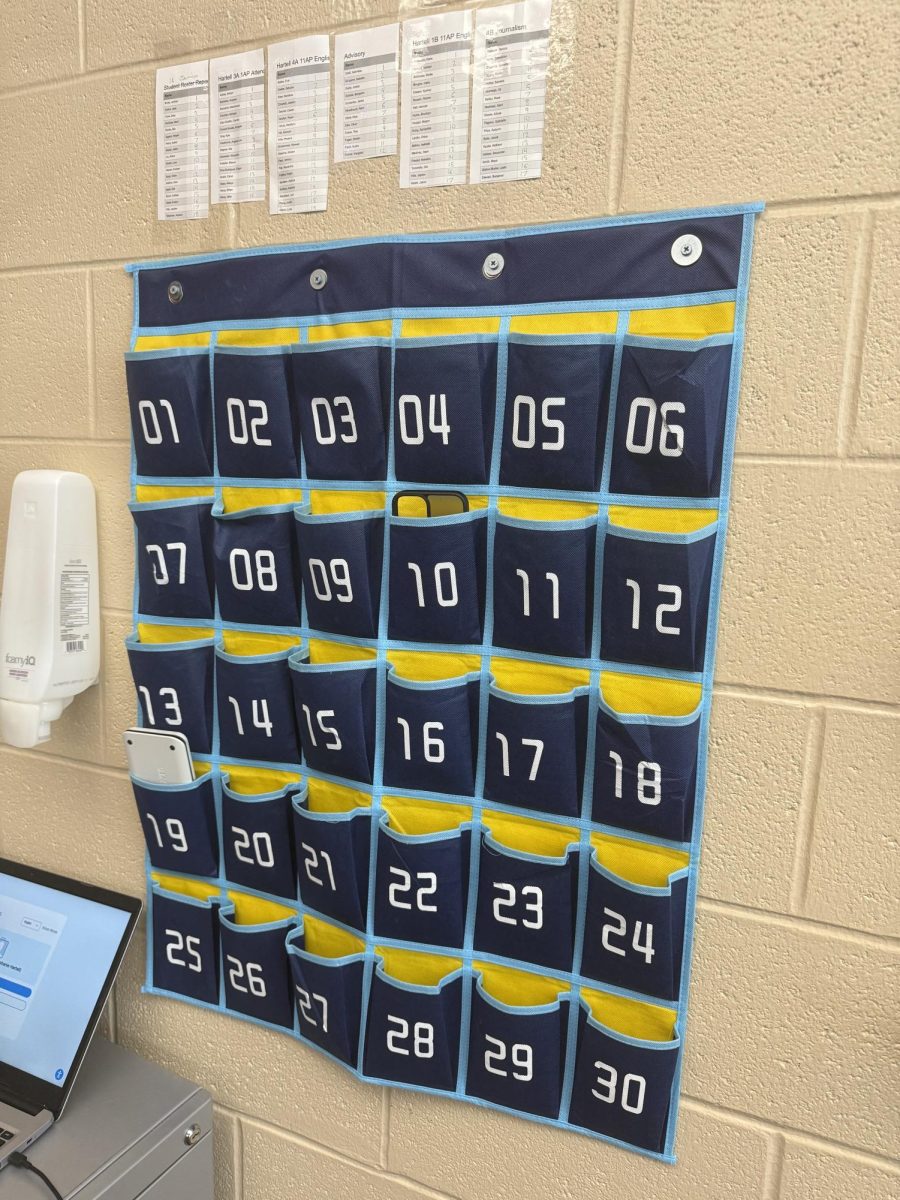
Phones are ringing, but no one’s answering. This would have been the reality if Connecticut’s House Bill 5035 passed the Senate. On May 6, 2026, a bill to ban phones in CT schools died in the Senate for the second year in a row, despite heavy support from Governor Ned Lemont.
Phones in schools are a debated topic because people have come to rely on having access to the world in their back pocket. At the start of Waterford High School’s 2025-2026 school year, administration and teachers began to more strongly enforce phone policies. But students have still found ways around the phone caddies. From empty phone cases to fake phones being left in students’ slots, it is clear that the WHS policy is not entirely effective.
In 35 other states, legislatures have already passed laws restricting phone use in schools, most of which require districts to implement “bell-to-bell” regulations on phones. In our own state, many individual districts have also implemented phone regulations more severe than that of Waterford High School.
Yondr is a company founded in 2014 that in recent years has made headline news. Yondr’s biggest product is the Yondr Pouch. As stated on their website, once a person enters a “phone-free space,” phones will be placed inside the pouch and will be sealed inside using a magnetic lock. If a person needs to use their phone, they must first leave the space and unlock their pouch, using an “unlocking base.” The Yondr website reports that 83% of schools who use Yondr pouches observed increased student engagement, but it is unclear how this statistic was obtained.
The issue with the pouches is a question that is raised whenever restrictions on phones in schools are discussed: how will I contact my child? A major parent and student concern is whether or not they will be able to get in touch with each other in the case of an emergency, something that would be significantly more difficult if student phones are locked away. Though the pouches cannot block signals from reaching a phone inside, having masses of people trying to unlock their pouches during an emergency is much more difficult and dangerous than simply grabbing the phone from the phone caddies. Though some may say that Yondr pouches and similar phone regulations should stay out of schools, they may be a necessity.
According to Pew Research Center, 72% of high school teachers in the US say that phones are a “major problem” in schools. Additionally, 60% say that enforcing phone policies is very/somewhat difficult. By having a strict ban on phone use during schools this problem can be reduced, and by using Yondr pouches or other phone restricting devices, the rule can be more easily enforced.
Whether or not you think Yondr pouches are the best way to regulate phones in schools, and despite the Connecticut bill dying, big changes are coming. Current phone policies are not working as they should, and with the rise of AI chatbots, regulating phones in schools should be a priority.