

With an increasing prevalence of fast fashion stores, businesses that have unethical supply chains, clothing material that damages the environment, and companies that use exploitative labor practices, it is beneficial to prioritize shopping at nonprofit businesses.
According to Earth.Org, “roughly 85% of all textiles go to dumps each year, with one garbage truck full of clothes incinerated or landfilled every second.” Fast fashion production accounts for a large amount of global carbon emissions, driven by energy-intensive dyeing and manufacturing.
Forced labor also plays a huge part in many companies today. In 2024, research found allegations of forced labor in the supply chains of 46% to 54% of analyzed fashion companies. A report by the International Labour Organization says that “Around 27.6 million people are currently trapped in forced labor.” That’s more than the population of New England.
What can we do about this? By shopping at nonprofit organizations, environmental and labor issues are directly addressed by keeping clothing in a “circular economy.” By prioritizing the reuse of existing items, these organizations reduce the global demand for new fast fashion production, which is the primary driver of both carbon emissions and labor exploitation.
Nonprofits provide an ethical alternative to the traditional retail supply chain by shifting focus from corporate profit to community development. Their primary goal is to fund social services and community programs that help a specific group, such as domestic abuse victims, people in poverty, healthcare and illnesses, individuals with disabilities, animal rescue, and immigrants.
Nonprofit businesses use their revenue to fund a wide range of social services for vulnerable populations. By shopping at or donating to these groups, you support programs that range from immediate crisis relief like food and shelter to long-term economic empowerment through job training and education.
Below are a few reputable nonprofit businesses in the eastern Connecticut area.
Habitat for Humanity of ReStore
Conveniently located in Waterford and a short drive from the high school.
The ReStore offers appliances, furniture, and building materials to benefit Habitat for Humanity, which is an organization that works with the community and families to build homes and hope.
Through partnership, households can gain stability through affordable ownership. In addition to shopping at their furniture store, they also have many volunteer opportunities such as helping to build homes on site, working in ReStore, or supporting events.
They have partnered with more than 110 families since 1987, to build better lives through affordable and safe homeownership. Near the end of 2025, Habitat for Humanity of Eastern Connecticut reached a lifetime milestone of 120 completed homes across its local region.
Maria’s Treasures
Located in Norwich, Maria’s Treasures operates as a non-profit thrift store that exemplifies the “shop local, give local” business model.
Unlike traditional retail outlets, the store is managed and staffed entirely by volunteers, allowing it to direct 100% of its profits toward support service agencies throughout southeastern CT. In 2025 alone, the organization was able to donate $118,506 to various local causes, ranging from food pantries and emergency services like the Taftville Fire Department to regional nonprofits such as the Madonna Place and the Terri Brodeur Breast Cancer Foundation.
By transforming donated furniture, clothing, and household goods into critical financial resources, Maria’s Treasures serves as a vital bridge between community generosity and the urgent needs of local individuals and families.
Pandemonium Thrift Shop

Operating out of a historic property, the Pandemonium Thrift Shop serves as the primary funding engine for the Pandemonium Rainforest Project, a nonprofit dedicated to the rescue and rehabilitation of exotic animals.
The shop specializes in a selection of vintage clothing, books, furniture, and unique collectibles, with 100% of its proceeds supporting the care of abandoned or neglected reptiles and parrots. This extraordinary business integrates retail with animal welfare.
The shop features a cafe and sanctuary where visitors can see the very animals, such as tortoises and tropical birds, that their purchases help protect. By transforming donated home goods into medical care, specialized food, and habitat restoration for exotic species, Pandemonium has become a notable example of social enterprise that revitalizes local historic spaces while addressing the specialized needs of animals often overlooked by traditional shelters.
Homeward Bound Treasures
Based in downtown New London, Homeward Bound Treasures is a non-profit thrift store that functions as the primary fundraising arm for the New London Homeless Hospitality Center.
Located in a historic building known as the “Carriage House”, the shop specializes in high-quality donated furniture, home decor, electronics, and appliances. Beyond simply raising funds to support the NLHHC’s emergency centers and respite programs, the store operates with a dual mission which is to provide affordable household essentials to low-income families and serve as a job training site for individuals experiencing homelessness.
By offering both a “hand up” through employment and a sustainable revenue stream for regional house services, Homeward Bound Treasures demonstrates how a retail business can be leveraged to address the root causes of housing instability in the community.
Sarah’s Cupboard
Tucked away by the shoreline in Madison, Sarah’s Cupboard serves as a vital revenue stream for the SARAH Foundation, an organization that has supported local individuals with intellectual and developmental disabilities since 1957.
This boutique-style thrift shop is fueled by community donations of clothing, jewelry, and home goods, with 100% of the proceeds directly funding residential services and vocational training.
By converting retail sales into social impact, Sarah’s Cupboard provides the financial backbone for regional organization agencies like Sarah Tuxis and SARAH SENECA, ensuring that hundreds of residents across southern CT have access to the resources they need to live independent and fulfilling lives.
COMO Thrift Shop – Stonington Community Center 
Located in Stonington, the COMO Thrift Shop is one of the oldest in the region, established in 1947 to pivot wartime relief efforts toward local community support.
Today, it serves as a critical fundraising engine for the Stonington Community Center, a hub that has provided educational and recreational programs since 1945. By selling a curated mix of donated vintage apparel, housewares, and collectibles, this shop directly funds a wide array of civic services, including NAEYC accredited preschool programs, youth athletics, and a public pottery studio.
The business model emphasizes environmental sustainability through “repurpose and reuse,” while functioning as a social spot where volunteers and neighbors connect to sustain the center’s mission of lifelong learning and community engagement.
Two Wrasslin’ Cats Coffee House & Cafe 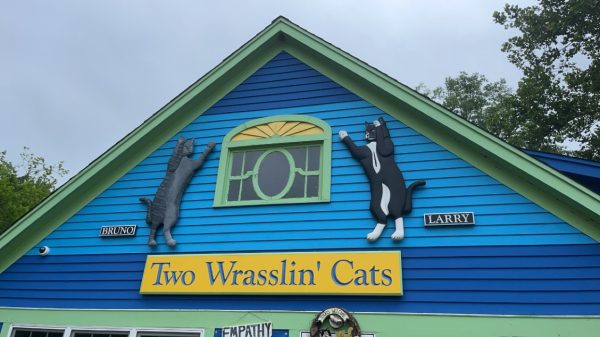
Located in East Haddam, Two Wrasslin’ Cats Coffee House & Cafe is a unique “sanctuary restaurant” and community hub that operates alongside the Two Wrasslin’ Cats Accord, a non-profit organization.
Housed in a colorful historic Cape Cod style building, the shop was founded by Mark Thiede, a former molecular biologist who transitioned from corporate life to create a space centered on social justice and community connection. While the cafe serves carefully crafted coffee and homemade baked goods, its primary mission is to support the Accord’s initiatives, which provides grants to local organizations advocating LGBTQ+ rights, racial equity, and reproductive freedom.
The cafe also features a dedicated cat lounge that supports animal welfare partners through trap, neuter, and release programs, demonstrating a unique business model where retail serves as a vessel for local advocacy and philanthropy.
Havenly – Community Cafe & Homestyle Kitchen
Located in New Haven, Havenly is a non-profit social enterprise that utilizes a community cafe and homestyle kitchen to empower refugee and immigrant women.
Moving beyond a traditional charity model, Havenly operates as a six month paid fellowship where participants receive 15 hours of weekly experience in a commercial kitchen alongside 100 hours of classroom instruction in English, digital literacy, and civic rights.
The cafe’s menu features authentic Middle Eastern and international dishes, like the Baghdad bowls and vegan baklava, with 100% of the revenue reinvested into these educational programs and the Havenly Women’s Financial Network.
By transforming a downtown restaurant into a training ground, Havenly helps women transition from “survival jobs” into stable careers in healthcare, culinary arts, and business, while building a self-sustaining mutual aid network for local families.
